Agenda
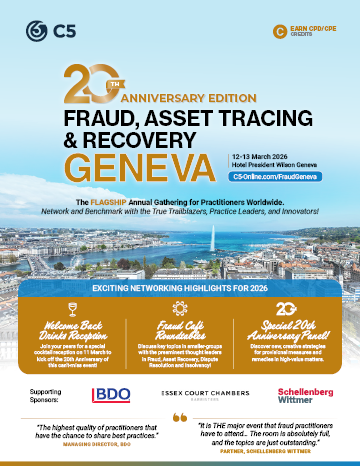
Flip through our conference brochure and discover what’s new this year.
Download Brochure
Pre-Conference
March 11, 2026
Welcome Back! Drinks Reception at La Potinière Genève
Le, Jard. Anglais, 1204 Genève, Switzerland (a short walk from the Hotel President Wilson)
Sponsored by

Day 1 — Main Conference
March 12, 2026

Registration & Networking Breakfast Sponsored by 


Dmytro MarchukovPartnerImpacta Law (Ukraine)

Joanna BogdańskaPartnerKW Kruk and Partners (Poland)

Alexander Brown KCBarristerOne Essex Court (UK)

Audrey ByrnePartnerMcCann FitzGerald LLP (Ireland)

Avi DasSenior Managing Director & PartnerFTI Consulting, Inc. (EMEA)

Matthieu GregoireBarristerEssex Court Chambers (UK)

Bruno MortierSenior Manager, Corporate Intelligence ServicesBDO (Germany)

Antonia MottironiAttorney-at-Law and FounderArdenter Law (Switzerland)

David MizrachiFounding PartnerMDU Legal (Panama)

Matthias NiedermüllerManaging PartnerNiedermüller Law (Liechtenstein)

Christopher A. NoelPartnerSequor Law (USA)

Stavros PavlouExecutive ChairmanPatrikios Pavlou & Associates LLC (Cyprus)

Aimée PrietoPartnerPrieto Cabrera & Asociados (Dominican Republic)

Fabio TrevisanPartnerBonn Steichen & Partners (Luxembourg)

Jane ColstonPartnerBrown Rudnick LLP (UK)
Settle in and connect in smaller-group settings for interactive, ice-breaking sessions that will operate as a series of Roundtable discussions on hot button issues. Our speakers will rotate to a different set of tables after each 30-minute session.
- Mitigating Reputational Risks in the Crosshairs of Fraud and Asset Recovery: Fine Tuning Your Messaging and PR Strategy
- Thinking Like a Fraudster: Special Considerations and Tactics for Tracking Down the Elusive Fraudsters and Assets
- Overcoming Evidentiary Challenges in Complex Fraud Matters: Successfully Pursuing Fraud Claims in Jurisdictions with Differing Disclosure Obligations
Break
Audience Polling and Interactive Q&A
A Multi-Disciplinary and Multi-Jurisdictional Examination of Fraud and Asset Recovery: Tools, Specialties and Unique Approaches to Recover for Your Clients

Nat AbramovFounder Crystal Vantage (UK)

George AyoubPartnerSchellenberg Wittmer LTD (Switzerland)

Andrew McLeodBarrister One Essex Court (UK)

Simon OttPartnerSchurti Partners Attorneys at Law Ltd (Liechtenstein)

Dorothy SironPartner Stephenson Harwood LLP (Hong Kong)
In big ticket, multi-jurisdictional fraud and asset recovery matters, there are multiple – but often hidden – approaches available to achieve recovery. Join us in this session as our panel opens the floor for discussion on identifying the variety of tools that can be implemented in unique asset recovery matters, including:
- Identifying and employing vulnerabilities in negotiation:
- Unknown or unpublished history of wrongdoing
- New partners or business ventures with parties that are unaware of fraudulent activity
- Reputational attacks and tactics
- Criminal conduct that may form the basis of complaints to law enforcement
- Utilizing whistleblowers and disgruntled former insiders
- Leveraging non-legal practitioners for negotiation, pressure and settlement opportunities
- Identifying discovery tools and prejudgment remedies available in different jurisdictions
- Freezing orders and preliminary injunctions that can survive multi-jurisdictional attacks
- Norwich Pharmacal / Bankers Trust– third party disclosure orders
- Section 1782 proceedings
- Attachment / receiverships
Dissecting the Interplay Between Common Law and Civil Law in Complex, Multi-Jurisdictional Fraud and Asset Recovery Proceedings

Jonathan AddoPartnerHarneys (British Virgin Islands)

Hannah BlechaPartnerSchwarzler Attorneys at Law (Liechtenstein)

Sarah MurrayPartnerFox Williams (UK)

Douglas PaineBarristerOne Essex Court (UK)

Barry RobinsonDirector, Head of Forensic ServicesBDO (Ireland)
Cross-border fraud and asset recovery cases demand agility and forward thinking when navigating both common law and civil law frameworks. Practitioners need to closely examine strategic considerations in choosing jurisdictions, timing applications, and managing conflicts between procedures – as well as tactics for overcoming enforcement and evidentiary hurdles.
Join us in this session as we utilize real-world scenarios to provide you with actionable guidance on forum selection, cooperation with local counsel, and leveraging procedural differences to trace, preserve, and recover assets efficiently across borders. Topics for discussion include:
- Understanding the key procedural and evidentiary differences between common law and civil law systems in fraud and asset recovery matters
- Identifying and deploying effective interim remedies across multiple jurisdictions:
- Freezing orders
- Disclosure
- Civil confiscation
- Developing strategies for overcoming enforcement barriers, including financial institution secrecy, evidentiary limitations, and conflicts of law
- Practical insights into coordinating with local counsel, selecting forums, and sequencing proceedings to optimize recovery outcomes
- Simultaneous civil and criminal proceedings
- Discovery improvement – or barriers – when criminal authorities are engaged
- Civil confiscation regimes
Conference Luncheon Sponsored by



Cross-Border Insolvency and Restructuring: Ongoing Developments Affecting Enforceability, Asset Tracing and Recovery

Tara Archer-GlasgowPartnerHiggs & Johnson (The Bahamas)

Christopher LeversPartnerOgier (Cayman Islands)

Richard Millett KCBarristerEssex Court Chambers (UK)

Eddee NgJoint Managing PartnerTan Kok Quan Partnership (Singapore)
Cross border insolvency laws present a complex landscape within which fraud practitioners must navigate, with an eye towards geopolitical tensions, class priorities, foreign substantive law, and an array of other foreign insolvency and fraud-related proceedings.
Topics for discussion include:
- Utilizing Insolvency and Restructuring as mechanisms for exposing fraud, detecting and recovering assets
- Large-scale frauds with multiple victims and assets: Initiating and following insolvency claims simultaneously in more than one jurisdiction
- Navigating through global cross-border insolvency and restructuring laws
- Comprehensive strategies on debtor-side assignments and practical tips for handling complex and sophisticated creditor rights matters
Break
20TH ANNIVERSARY PANEL | Part I
Asset Recovery as a Discipline: How It All Started, Where We Are Now; and Where We Are Headed

Edward H. Davis, Jr.Founding ShareholderSequor Law (USA)

Martin KenneyFounder & Head of FirmMKS Law (British Virgin Islands)

Yves KleinPartnerMonfrini Bitton Klein (Switzerland)

Maureen WardPartnerWeirFoulds LLP(Canada)
Don’t miss this landmark session featuring some of the most seasoned and respected voices in fraud and asset recovery. Drawing on over two decades of hard-fought lessons, this panel of thought-leaders will reflect on the defining challenges, pivotal shifts, and enduring truths that have shaped asset recovery, and where the next era is headed. Topics of discussion will include:
- Examining how multiple judicial and regulatory efforts over the last thirty years have recognized the practice area of asset recovery.
- Reviewing how the current legal and cultural landscapes have changed with the evolution and recognition of asset recovery as a practice area.
- Forecasting the future of challenges to and opportunity in the practice of asset recovery

End of Day One / Networking Cocktail Reception
Day 2 – Main Conference
March 13, 2026
Leveraging Artificial Intelligence in Fraud and Asset Recovery: Real World Applications of AI in Fraud Detection, Due Diligence, Data Analysis and Authentication

Christopher WhitehouseOf CounselReynolds Porter Chamberlain LLP (UK)
Jane ColstonPartnerBrown Rudnick LLP (UK)
Bruno MortierSenior Manager, Corporate Intelligence ServicesBDO (Germany)
As fraud schemes grow more sophisticated and financial crimes grow in complexity and scale, fraudsters are utilizing increasingly complex methods to acquire their ill-gotten gains. As such, traditional investigative methods are struggling to keep pace and the integration of artificial intelligence into investigative and asset recovery processes is rapidly transforming the landscape.
There are limitations and challenges with utilizing AI in fraud and financial crime investigations, so it is critical to gain a solid understanding of how to best utilize these tools to avoid errors and misdirected resources. Be sure to join us in this session as we examine best practices for utilizing AI-tools in asset recovery. Topics for discussion include:
- Techniques for enhancing due diligence and forensic accounting
- Challenges around data quality, legal admissibility, and algorithmic bias
- Digital forensics and decentralized finance transactions
- Best practices for expediting the process of cross-border asset tracing and recovery
- Integrating AI into a hybrid approach to combine the technology with human expertise:
- Critical thinking
- Result interpretation
- Strategic decision making

Break
Audience Polling
Confiscation of Assets: Collaborating with Government or Local Law Enforcement to Aid in Recovery for Your Clients

Michael AdkinsPartnerCollas Crill (Guernsey)

Evelyn Baltodano SheehanPartnerKobre & Kim (USA)

Karyn A. HartyPartnerDentons (Ireland)

Nicosia LawsonCrown Counsel IOffice of the Director of Public Prosecutions – Cayman Islands Government (Cayman Islands)
As fraud continues to increase globally, it is critical to have a procedure in place for the confiscation of assets. In addition, practitioners must effectively collaborate with the law enforcement authorities to exercise due diligence in enabling effective value-based and conviction-based asset forfeiture.
Join us in this informative and interactive discussion, as our panel of experts discuss the:
- Type of authorities in several jurisdictions that are entitled to confiscate:
- Criminal
- Regulatory
- Corporate
- Limitations when a corporation has generated profits through legitimate business activities; versus profit that is generated from corruption
- Methods that are used to determine the magnitude of the confiscation:
- Profits generated
- Costs to be accounted for
- Extent of wrongdoing and fraudulent activity
- Procedures for the sharing of confiscated proceeds between jurisdictions
- Different types of resolution in these matters; and considerations for determining if there is still a place for trials in confiscation matters
Corporate Liability for Failing to Spot or Prevent Fraud: When Can an Organization Be Prosecuted or Found Liable for Failing to Prevent Fraud or Other Economic Crime Offence?

Ilias AnagnostopoulosPartnerAnagnostopoulos (Greece)

Sophie EyrePartnerBird & Bird (UK)

Grzegorz WoźniakManaging PartnerWoźniak Legal (Poland)

Oren J. WarshavskyPartnerBaker & Hostetler LLP (USA)

Richard BurgerPartnerCharles Russell Speechlys (UK)
Many fraudulent schemes involve corporations or financial institutions because most money transfers and trading still have to be done through large organizations and banks. These entities and their employees are, therefore, in a position that may enable them to spot and block or report suspected fraud. But what about civil liability for failing to spot potentially fraudulent behavior?
For many of these organizations there is the particular problem of the civil and criminal liability imposed on them for failing to spot fraud negligently (as opposed to deliberately). Do these organizations owe a duty of care not to execute the customer’s order if it knows the order to be dishonestly given, or shuts its eyes to obvious dishonesty, or acts recklessly in failing to make inquiries? Join us in this session as we discuss some of the scenarios in which corporations and financial institutions can be found liable for fraud, and the barriers to recovery. Topics for discussion include:
- Civil, regulatory and potential criminal liability
- The UK Failure to Prevent Fraud (FTPF) offence:
- The scope of criminal liability for large organizations if an “associated person” (employee, agent, subsidiary) commits a fraud offence intended to benefit the organization:
- Were the fraudsters actions intended to benefit the organization
- The actual receipt of a tangible “benefit” is not required
- Defining if “reasonable fraud prevention procedures” are adequate and in place
- Limitations and restrictions on acquiring the necessary data to prosecute or open formal investigations
- Liability for actual and additional damages
Conference Luncheon Sponsored by
Bridging the Gap in Asset Recovery: Actionable and Proven Strategies for Breaking Down the Barriers and Obtaining Recovery for Victims of Fraud
Maureen WardPartnerWeirFoulds LLP(Canada)

Daniel J. ZappelliPartnerVafadar Sivilotti Zappelli (Switzerland) Former Attorney General of the Republic and District of Geneva

Costas StamatiouFounding PartnerCostas Stamatiou Law Firm (Cyprus)

Alexander ThavenotHead of Disputes & InvestigationsSimmons & Simmons LLP (UK)
Most victims of fraud are primarily concerned with how they can recover from the losses that they have suffered due to fraudulent activity. Unfortunately, there is often a sizeable gap between orders of restitution and what the victims are actually able to recover.
In many fraud cases, restitution may be ordered where victims of the fraud have suffered the loss of money or other tangible assets, but there are significant barriers in the way of being compensated. Join us as our panelists discuss how to overcome these barriers – including:
- Insolvency
- Jurisdictional hurdles
- Evidential challenges
- Difficulty in valuing and recovering exotic assets
- Issues with obtaining injunctive remedies in challenging jurisdictions
20TH ANNIVERSARY PANEL | Part II with Audience Q&A
Cross-Border Procedural Tricks and Tactics: Overcoming High Stakes Obstacles to Recovery

Héctor SbertPartner ECIJA (Spain)

Tomislav ŠunjkaPrincipalŠunjka Law (Serbia)
In an asset recovery case, it’s very important to identify the right tools to use; and gather all the pertinent information which more often than not lies outside the jurisdiction of the fraudster and the victim. The ability to identify and retrieve information from a wide array of sources which may be spread across numerous jurisdictions – and in different languages – is critical.
Join us in this unique and interactive session, as our speakers and attendees provide an international perspective on the biggest challenges they experience in fraud and asset recovery matters, including an examination of the different approaches taken to disclosure & discovery in Civil and Common Law jurisdictions.
- Bring your questions, as our experts address some of the most pressing and difficult challenges that confront fraud and asset recovery practitioners in complex matters, such as:
- Challenges in selecting the right forum(s) and venue(s) to prevent delay, gain momentum and improve chances of asset recovery
- Issues with obtaining and serving injunctive relief orders against unknown individuals and organizations
- What can be done to overcome a lack of cooperation between attorneys and enforcement authorities in the affected jurisdictions
- Handling the different approaches taken to disclosure & discovery in Civil and Common Law jurisdictions
End of Conference | Thank you!
Post-Conference
As in previous years, many of the delegates and speakers at C5’s flagship Fraud, Asset Tracing & Recovery – Geneva conference will be heading off to Chamonix at the close of the C5 conference for what is now the highly anticipated, fun-filled après-conference ski weekend. Chamonix is approximately 45 minutes to an hour away depending on traffic. There is no hotel booked for the weekend, but many will reserve a room at Chamonix-Mont-Blanc. All are welcome—whether skiers or not as the weekend is a great way to continue the bonhomie of the C5 Geneva event. For further details, please email: Leonie Stevens ([email protected]) and Sandrine Souvannavong ([email protected])
*Please note that the ski trip is not included in the conference registration fee and is not organised or hosted by C5.